
ONE of the most persistent tropes about police and government surveillance of citizens is the old line that, “If you’re not doing anything wrong, you’ve got nothing to worry about.”
But the past few months have brought a blizzard of headlines about ordinary citizens not doing anything wrong -- but still being victimized by abuse of the widening national network of Flock cameras.
Here are a just a few:
-- The Johnson County, Texas, sheriff’s office searched 83,000 Flock cameras across the entire country looking for one woman they suspected of leaving Texas to get a legal abortion out-of-state.
-- Brown County, Wisconsin, police tracked a man across state lines because they thought he was driving to Michigan to buy cannabis, where it’s legal.
-- In Dunwoody, Ga., Flock employees used their cameras to view a children’s gymnastics studio.
-- A Braselton, Ga., police chief used Flock cameras to track his ex-girlfriend and her teen daughter nearly 600 times. “Don’t worry I’m not tracking you or some weird stalker shit," he texted her. He committed suicide when it became public.
-- In Wisconsin last week, police shut down I-94 to pull over a car and hold the driver and passenger at gunpoint after Flock cameras mistakenly flagged the car as “connected to a homicide.”
-- The Sedgwick, Kansas, police chief used Flock license plate readers to track his ex-girlfriend 164 times and her new boyfriend 64 more times over 4 months.
-- The Lenexa, Kansas, police department used Flock cameras to track down a local resident after he wrote a guest column in the local newspaper critical of the department.
And of course there is the local case of six Savannah Police personnel being fired for abusing the Flock system to track people not suspected of any crime.
These are just a few examples. Over 50 police nationwide have been fired so far for abusing access to the Flock database.
Ethan Watters is a local activist against this increased, often-abused form of warrantless surveillance. He is also the president of the Lamara Heights Neighborhood Association.
“It’s frustrating, because police always explain it by saying ‘All Flock cameras do is read your license plate.’ But they do a lot more than just that,” says Watters.
These expanded capabilities are why Watters is quick to say that Flock cameras “are basically AI cameras. That’s what they should really be called.”
The City of Savannah has spent over $700,000 since 2020 on these AI-enabled cameras without a public vote.
Flock says it scans 20 billion license plates a month with ALPR cameras. Most police departments, however, show that ALPRs account for well under one percent of their annual crime clearance.
That means about 99 percent of Flock surveillance is collecting data on innocent people.
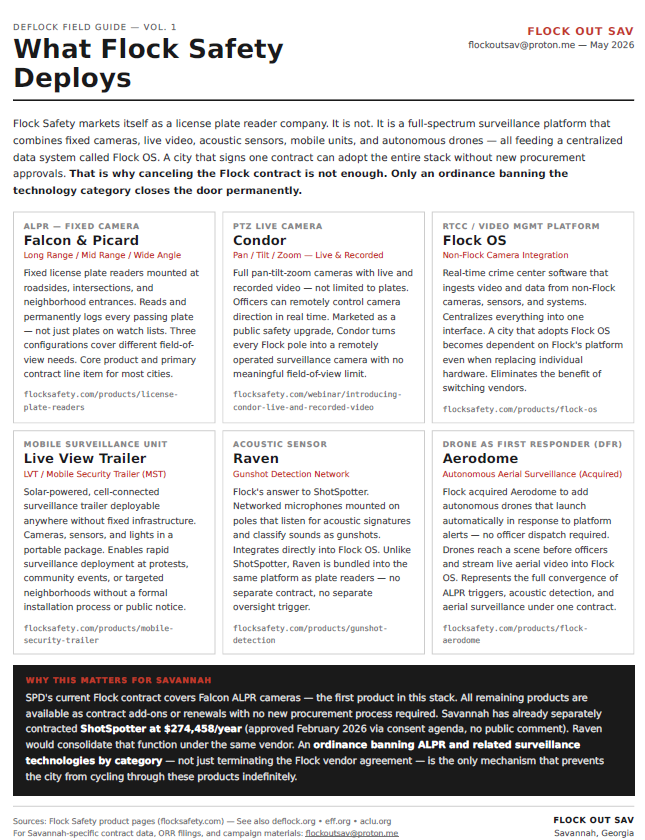
In public statements and press releases, police and politicians do usually only mention Flock’s ALPR (Automated License Plate Reader) functionality, which is provided by the base “Falcon” camera model.
But for a price, Flock offers a suite of additional services to law enforcement.
These add-ons include:
-- Condor camera system: Solar-powered remote control pan/tilt/zoom livestream cameras (currently used in Forsyth Park)
-- "Guardian" mode: a Condor camera feature which uses “object tracking,” i.e. tracking individuals not necessarily in vehicles.
-- Aerodrome: Weapon/camera capable drones
-- Live View Trailer: Portable “Mobile Surveillance Unit” that can be used to monitor any citizen rally or protest – say, protesting data centers
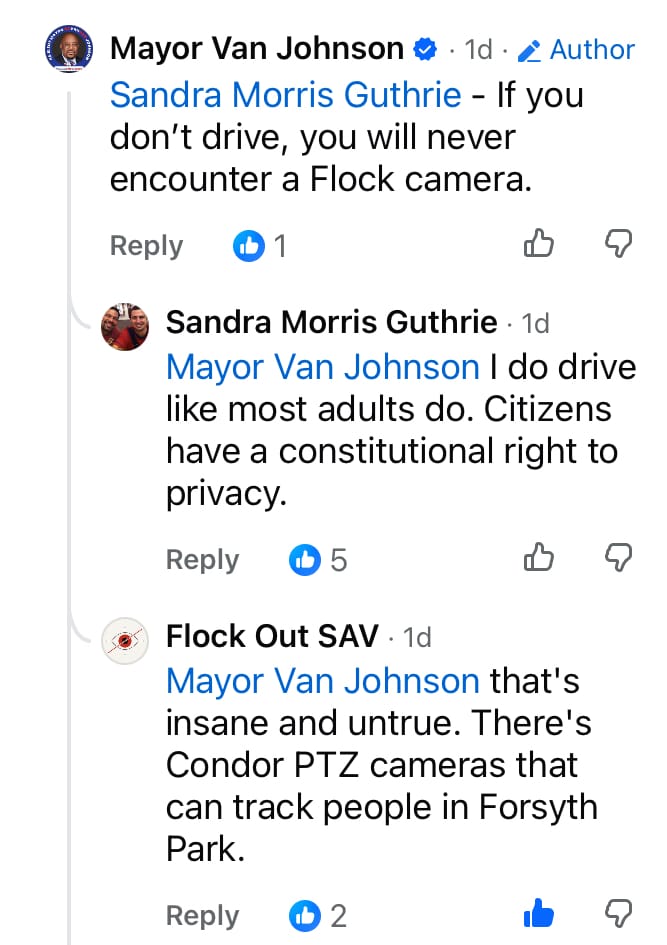
In the comments section of his post about the recent firing of the six SPD personnel, Mayor Van Johnson inaccurately said the Flock cameras only read license plates.
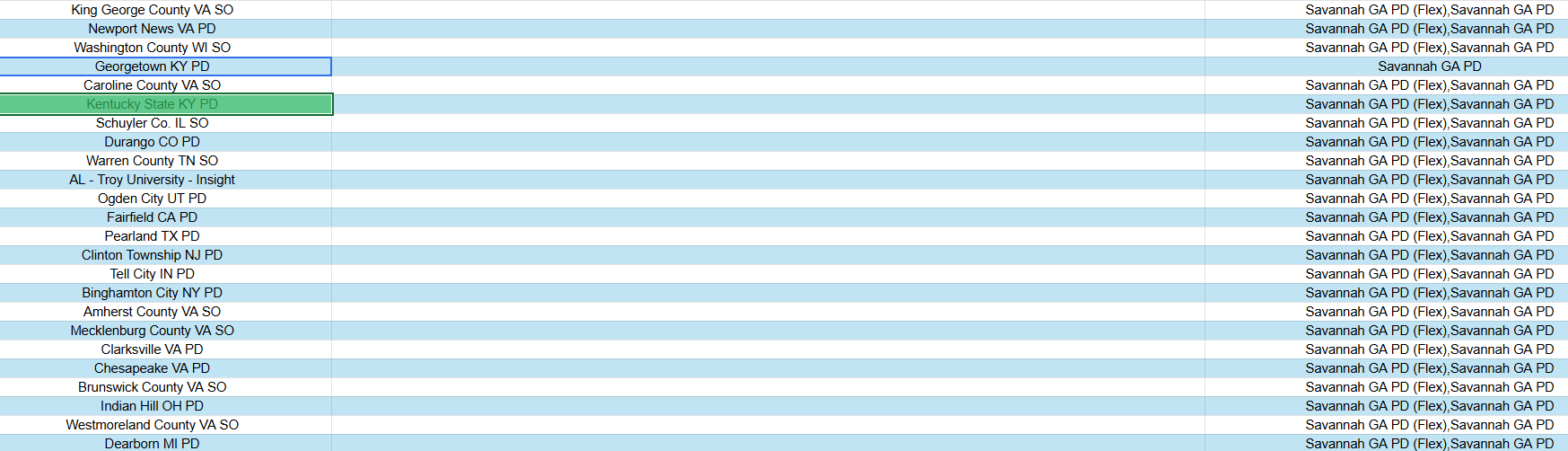
Savannah's Flock data is shared by over 1000 law enforcement agencies across nearly all 50 states.
“Why would a police department in Kentucky need to access our license plate records in Savannah?” asks Watters about just one example from a recent Open Records request.
“The overall through-line of all this is that they funnel all the data into one network, and they just fish for crime,” he says.
A few weeks ago, in the wake of numerous controversies involving police all over the country abusing access to Flock data, police and sheriff’s departments, began rolling out very similar-sounding social media posts pledging “transparency” in the use of Flock technology.
To many ears, the announcements almost seemed to be following the same script.
Watters cites the example of the Chatham County Police Department’s new “Transparency Portal” for the public.
These portals, he says, still rarely state a clear reason for a search. Generally, law enforcement simply makes one “Reason” choice from a simple dropdown menu.
Sometimes police can manually enter a Reason. For example, here a Savannah Police officer accessed 73 devices to track a Nissan entering “Work” as his reason.
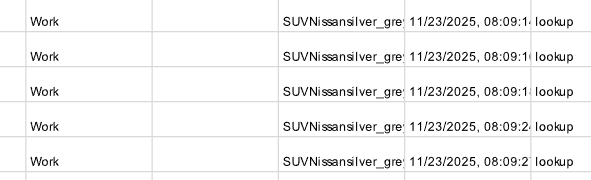
Other times, officers will write “Investigation,” “Inv,” or simply “Locate.”
In other cases, police select the ‘Test’ option” to cover their tracks, Watters says.
“That’s what we’ve seen used in a lot of the high-profile abuses of Flock. They just click ‘Test.’”
In the above-cited case of Texas cops tracking a woman for seeking an abortion, they just entered, “had an abortion, search for female.”
Roughly 90 percent of police Flock "transparency" portals don’t even feature a Case Number you can cross-reference, Watters says.
Just one of the reasons a Case Number might be important is if you’re one of the many innocent people around the country who have been stalked and harassed by police using Flock technology.
Further threatening civil liberties is the fact that Flock cameras routinely delete the footage depending on contractual obligations, sometimes as soon as 30 days.
Among other issues, this would make any lawsuit for civil rights violations that much harder to pursue.
To Watters, it’s no coincidence that Flock is an Atlanta-based company.
Atlanta is considered by most privacy advocates as the most surveilled major city in America.
“Flock is being billed as a Georgia startup success story,” he says. “But Atlanta is probably the most surveilled city in the world right now. And Flock wants to export that model to other cities. Do you want Savannah to be like Atlanta?”
Metro Atlanta has well over five thousand Flock cameras in operation, and has an incredible ratio of roughly one Flock camera for every ten residents.
The way Flock infects a municipality’s bloodstream offers some insight.
For one, their initial installation of cameras is surprisingly cheap – only about two grand per camera when a city first signs up.
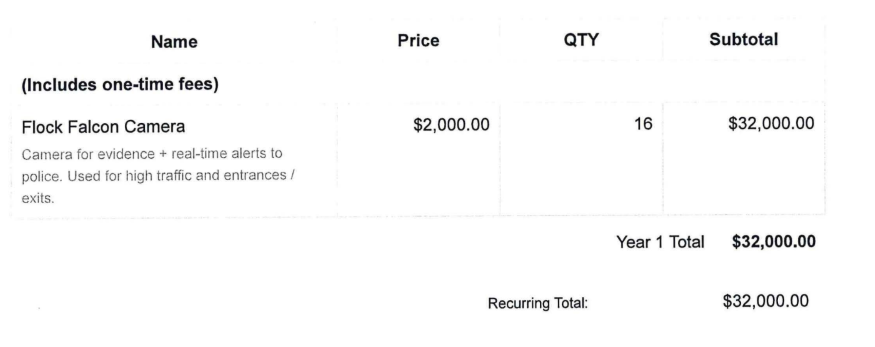
Why is this significant? It has to do with how bureaucracies work.
In the City of Savannah, for example, our City Council doesn’t have to make a public vote on any expenditure under $50,000. The City Manager’s office can just approve that kind of expenditure on its own.
The first batch of 16 Flock Falcon cameras the City of Savannah bought in 2020 cost taxpayers…. wait for it….
$48,000. Just under the threshold for a public vote.
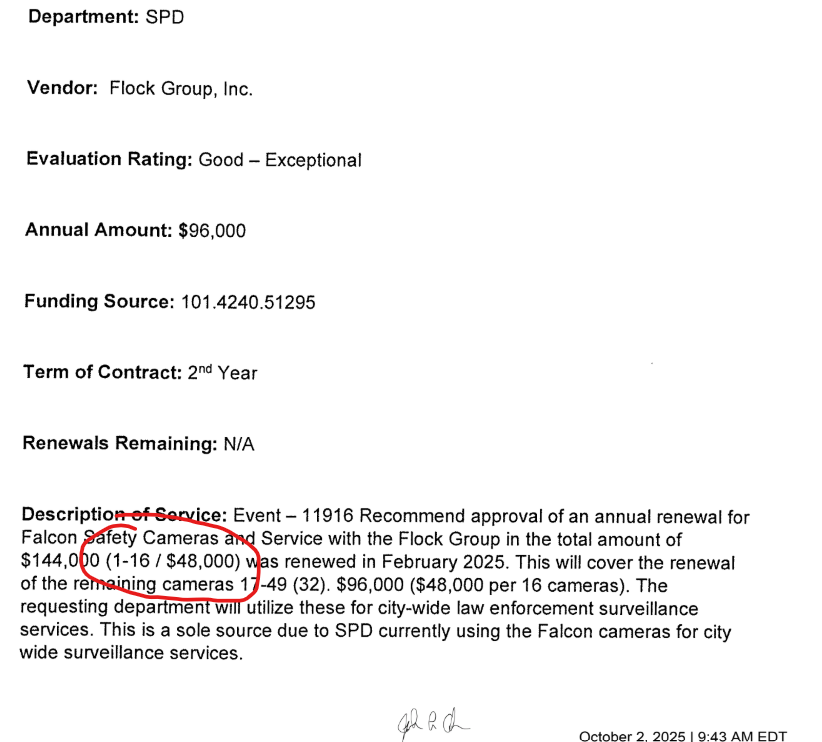
This situation was later made even more irresistible in Savannah’s case, when five years later the Savannah College of Art and Design gave the City a nearly million-dollar grant to fund the purchase of 70 additional Flock cameras.
This is the paperwork for the SCAD-funded purchase in late 2025:
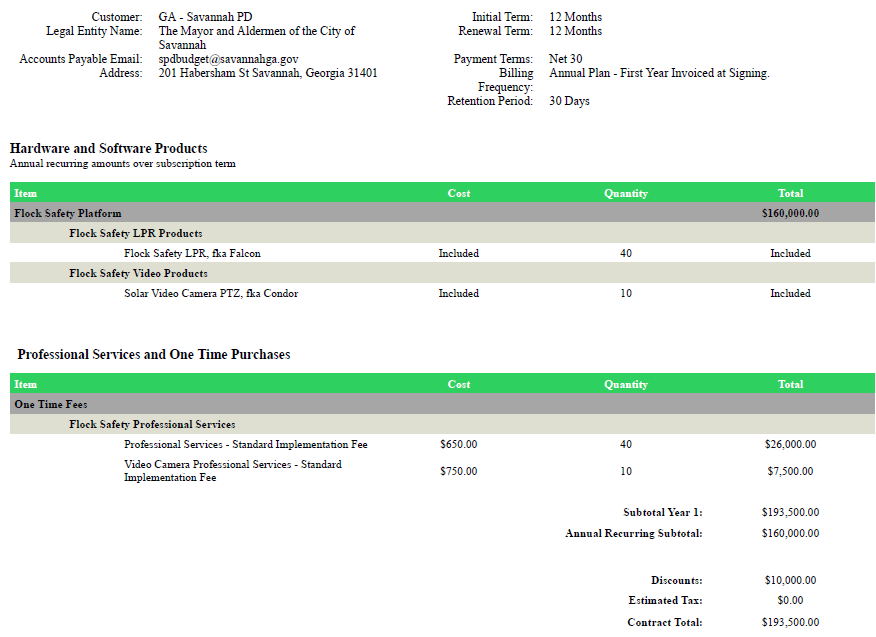
But after acquiring the actual cameras, City taxpayers, not SCAD, must maintain costly subscriptions to keep access to the precious data from the Flock cameras – which after all is the whole point.
“So the City ends up on an endless subscription, and the price keeps going up year after year, while your roads and schools continue to crumble,” Watters says.
Almost a third of the City of Savannah’s budget already goes toward “public safety.” And with every unsolved high-profile crime – such as the tragic acid attack in Forsyth Park that triggered the City to expand its Flock usage – there are calls for more and more funding.
Watters says none of this enhanced surveillance or increased funding has resulted in a measurable increase of the clearance rate of crimes – in other words, an increase in arrests of actual perpetrators.
In the case of Atlanta – America's most surveilled major city – the latest FBI data shows that clearance rates have not improved, and in some cases have gotten worse in the last five years, despite the virtual blanket of Flock coverage.
What Flock usage has resulted in so far is literally dozens of police all over the country caught in all forms of criminal abuse of the system, and many instances of totally innocent people being wrongly accused.
Citizens who attempt to file Open Records requests with local governments fight an uphill battle getting any meaningful information.
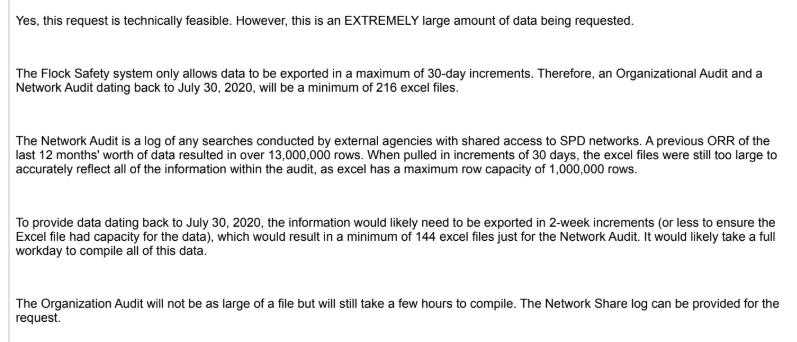
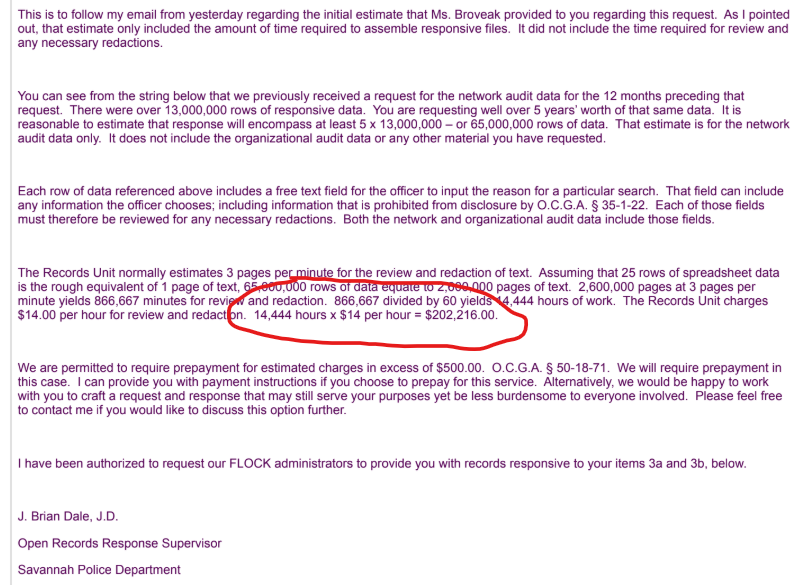
For example, one local activist requested SPD’s Organization Audit and Network Audit, routine documents compiled for clients by Flock.
The reply? It would cost this citizen over $200,000.
Here is the official reply, citing the large size of the file (which is only kept for 30 days):
And here is the specific citation of the cost of the Open Records request:
While in some high-profile cases, law enforcement agencies are canceling Flock contracts and instead going with tech surveillance products provided by the company Axon, Watters says that’s mostly a bait-and-switch.
“Flock and Axon basically do the same thing,” he says, pointing out that Axon already holds the majority of police bodycam contracts in the country.
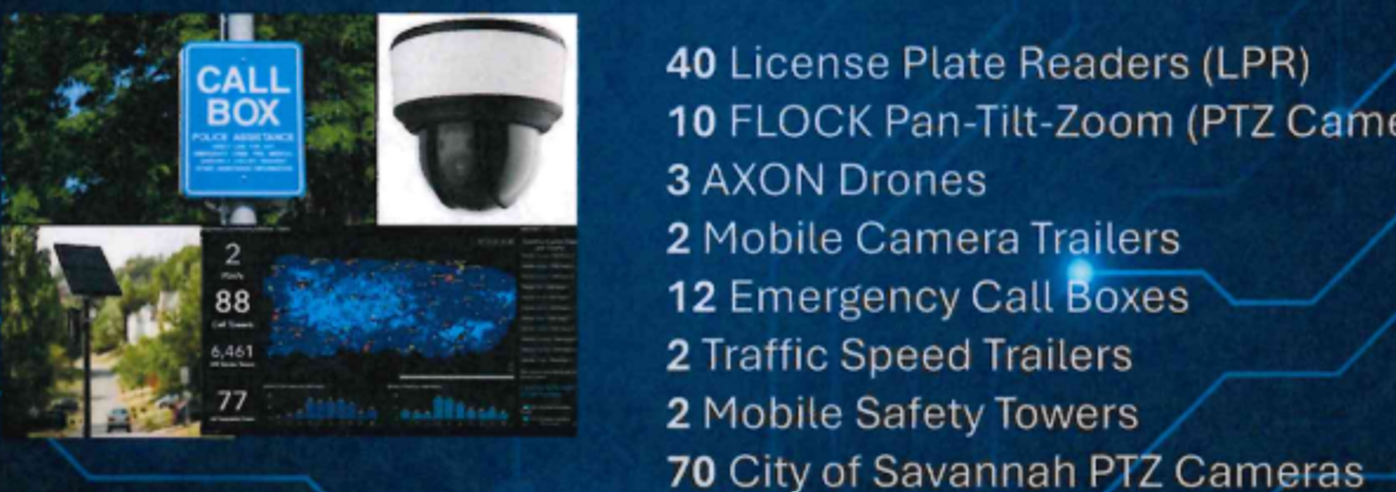
The City of Savannah, for example, uses Axon drones instead of Flock’s proprietary drones. But they serve the same purpose.
Watters and other privacy and civil rights advocates say that the only solution to Flock abuse is passing local ordinances banning the use of ALPR and related surveillance technology – not just terminating the Flock contract.
So in the face of this massive amount of political, institutional, and bureaucratic inertia and obstacles, how can citizens really make a difference in the fight against Flock?
Watters refers to the slang term “Copaganda,” i.e., the way citizens’ concerns about preserving their constitutional rights are often casually brushed away in the supposed interest of "public safety."
“We have to de-copagandize ourselves. Unfortunately one of the ways you have to do that is to quit watching the local TV stations. They just provide police department propaganda for the most part.”
Watters also cautions against “fanboying” political figures.
“We shouldn’t be idolizing politicians. We have to hold them accountable, even if we supported them and voted for them.”
Watters says we all need to continue to respectfully voice opposition.
And while participating in your neighborhood association, as Watters does, is a good start, it’s not enough.
“Connect not just with your neighborhood, but with your block. Try to define what is your neighborhood’s definition of public safety,” he says.
“And look through your City budget! Look at each and every City Council agenda every week.”
Follow Flock Out SAV here.
Access Savannah City Council agendas here.