
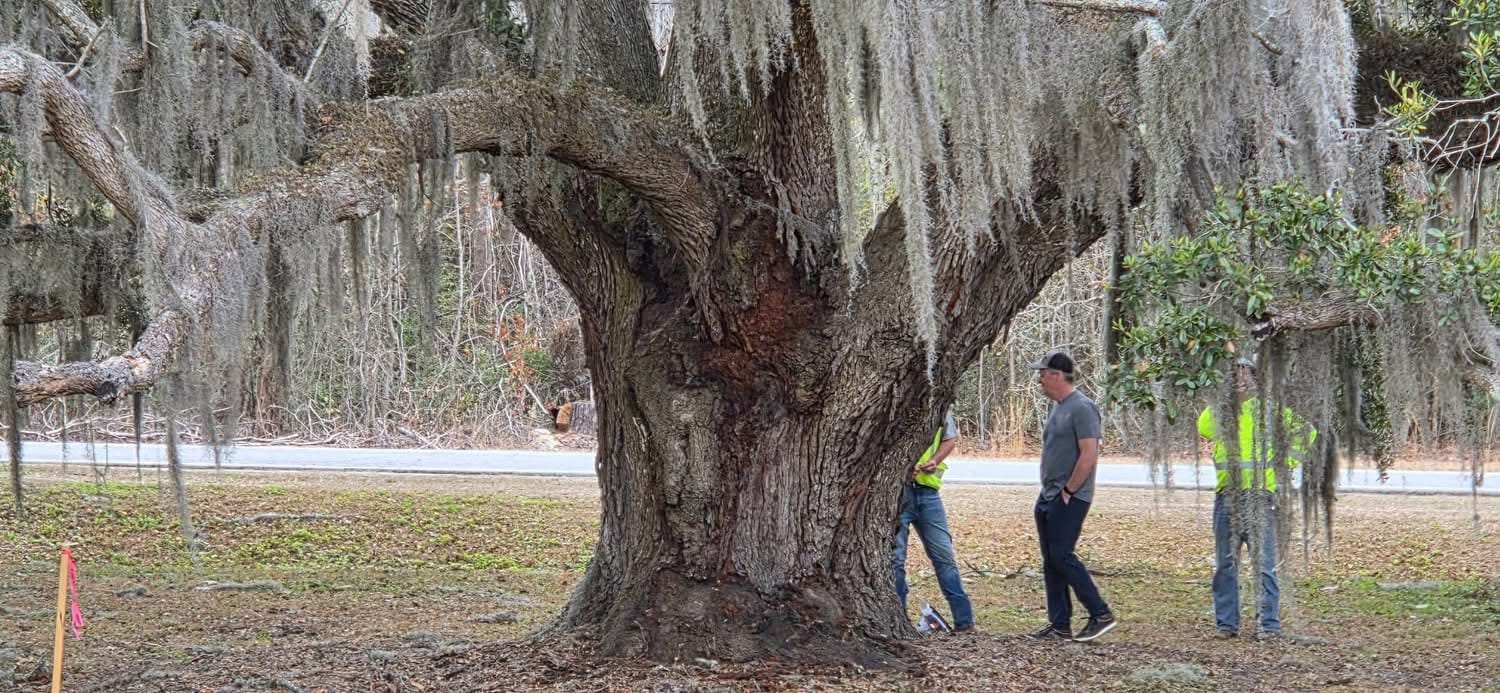
OVER the weekend, local social media was aflame over a planned destruction of a centuries-old oak tree in West Chatham County on Little Neck Road, to make way for new Georgia Power high-voltage power lines.
People from all walks of life were outraged. Some said they'd tie themselves to the tree rather than let it be cut down.
The reaction seemed a bit strong given everything else of an extremely dire nature that's facing Americans now, but perhaps this lone threatened tree on the side of the road represented one small battle against the powers-that-be that ordinary people thought they could successfully win.
While Georgia Power tepidly responded that the wood from the historic oak could be salvaged, no one was buying that as an acceptable alternative.
Georgia Power communications rep Joshua Peacock – formerly PR guy for the City of Savannah – even lamely tried threatening they'll have to raise your electric bill if the tree isn’t cut down:
“It means that rates won’t go up, it means that we can meet the demand and it takes the pressure off our families and small businesses,” he’s quoted in one report.
As I write this, the 300-plus year-old tree was given a reprieve – possibly a short one – by a Chatham County ruling that the oak is designated an “Exceptional” tree, and deserves special protection.
But let's not be naive. Georgia Power wields an enormous amount of political influence in the state, and they almost always get their way. Anyone familiar with how the utility and its subcontractors usually deal with trees anywhere near their power lines knows how this story is likely to end.
I’d love to be proven wrong, however.
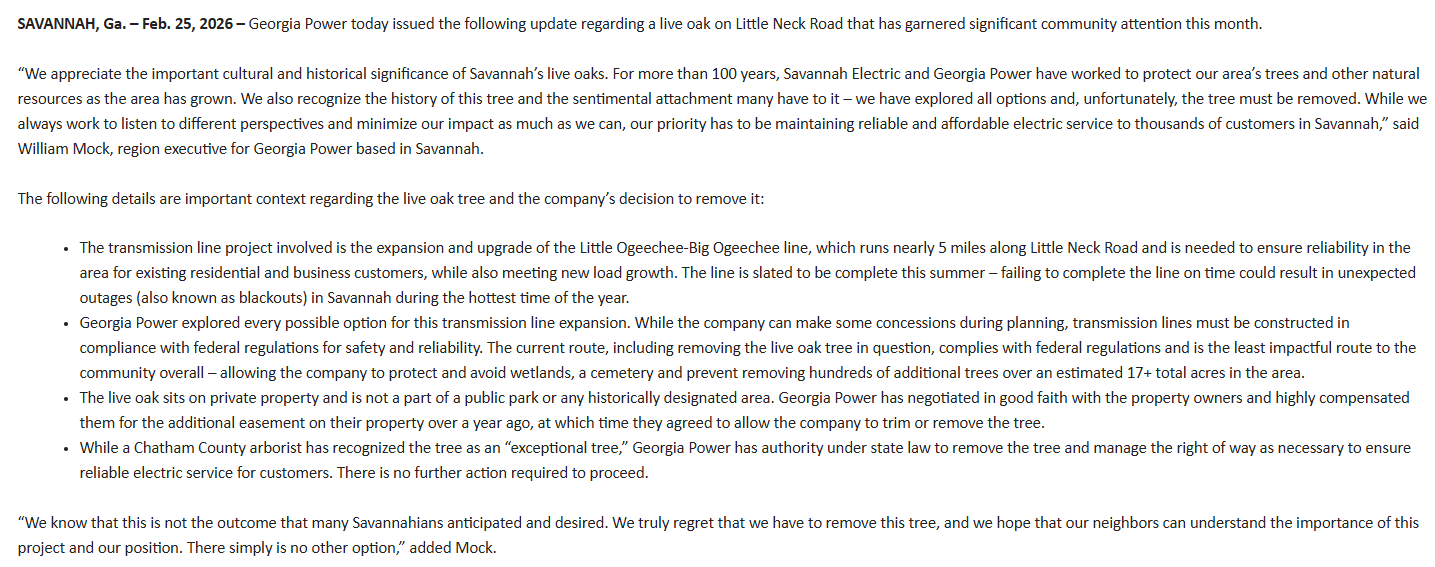
UPDATE 2/25: Unfortunately I wasn't wrong. Georgia Power has cut the tree down and offered the following justification via press release, essentially saying federal and state law – which includes Georgia Power's authority over rights-of-way – supersedes any local designation:
Of course the bigger picture here is that a literally unprecedented amount of new development, residential and industrial, is headed for semirural parts of Chatham, Bryan, and Effingham counties that have until now been able to be blissfully unconcerned with that kind of negative impact on the environment and infrastructure.
From Richmond Hill to Pembroke, Pooler to Port Wentworth, Effingham to Bloomingdale, previously sleepy local areas are facing an all-out development assault, as the last available parcels of undeveloped land are swept up by deep-pocket interests for warehouses, factories, and AI data centers.
In many cases, residents in these areas are fighting back, sometimes with success.
In this issue, Caitlin details the latest chapter in the fight against a nickel refinery near Richmond Hill, a project which now seems to have hit a possibly terminal roadblock.
Port Wentworth recently lost a fight against a new data center planned for their community, a town already decimated by expanding ports development. But at least they fought!
Also in Bryan County, a burgeoning grassroots movement – the closest thing to environmentalism you’ll see in that very conservative area – tries to hold Hyundai to account for the massive water usage planned for its EV Metaplant.
And nearly every week in various planning commissions, residents of West Chatham are pushing back against expanded residential and industrial developments -- which local politicians are notorious for approving despite no accompanying infrastructure improvements.
It’s ironic that the main environmental complaint in Savannah proper for literally 100 years – the International Paper mill, formerly Union Camp – recently shut down, after generations of spewing contaminants into that air and lungs and sucking water out of the Floridan Aquifer at a near-disastrous rate.
But that irony is also deeply symbolic in that it signals the final seismic shift in the local economic center of gravity further west, into previously undeveloped parts of the coast.
A key subtext here is that many of the corporations wanting to build the aforementioned warehouses, factories, and data centers clearly see the area to the west as ripe for the picking, not only for relatively cheap land but for the perceived political pliability of the residents.
Simply and bluntly put: People in Pooler, Port Wentworth, West Chatham and Bryan and Effingham counties have for decades reliably voted against environmental regulation of any kind.
Indeed, they often seem to think of even the smallest environmental regulation as proof of some sort of communist conspiracy.
But in a classic case of “Why is the Leopards Eating People’s Faces Party eating my face,” voters in these deep-red, politically conservative areas are now realizing that voting for Georgia’s Republican one-party rule doesn’t get them any brownie points at all when Amazon or Hyundai comes calling to their elected Republicans asking for sweetheart deals and tax incentives.
Better late than never, I guess.
In all fairness, I will say that their level of organization in the West Chatham/Bryan County grassroots is sometimes impressive.
Several large Facebook groups are very active, some of them specifically dedicated to fighting particular projects.
One of the first and most active is the group “It’s About WATER!!!” which has largely focused on the various permits sought by Hyundai not only for its main Metaplant off I-16, but its various supplier plants.
Unfortunately, comments in that group sometimes focus on the immigration aspect of the Hyundai plant – with false implications that they are “taking American jobs,” etc. – rather than the very real environmental impact of the plant.
More recently, I’ve been pleasantly surprised at how many posts in that group are calling out Rep. Buddy Carter, our area’s longtime Republican congressman.
It’s finally sinking in, at least for some of these likely lifetime Republican voters, that maybe not every single Republican has their best interests at heart.
While I am in no way deluding myself that anyone in West Chatham or Bryan County will convert into regular Democratic Socialist voters anytime soon, it’s good to see some amount of healthy activism finally entering the picture.
And in some cases, they can teach us more jaded folks in Savannah how to raise a ruckus when it’s called for.
All of us, no matter which political persuasion we are, face an unimaginably powerful effort by large corporations to extract every last ounce of water, minerals, and tax money while they can, while the U.S. regulatory environment is still so dramatically rigged in their favor.
It will require everyone working together to make even a dent in those plans.
Now is the time of mutual aid, a time of finding allies wherever they can be found.
Welcome to the party, pal! We've been waiting for you.