
By Nicole Moore, Cobblestone Tours
IN Savannah’s Old Burying Ground – or as you probably know it, Colonial Park Cemetery – two signers of the Declaration of Independence are said to be buried.
This honor is explained with pride and reverence, sometimes repeated by tour guides, and it is posted here and there.
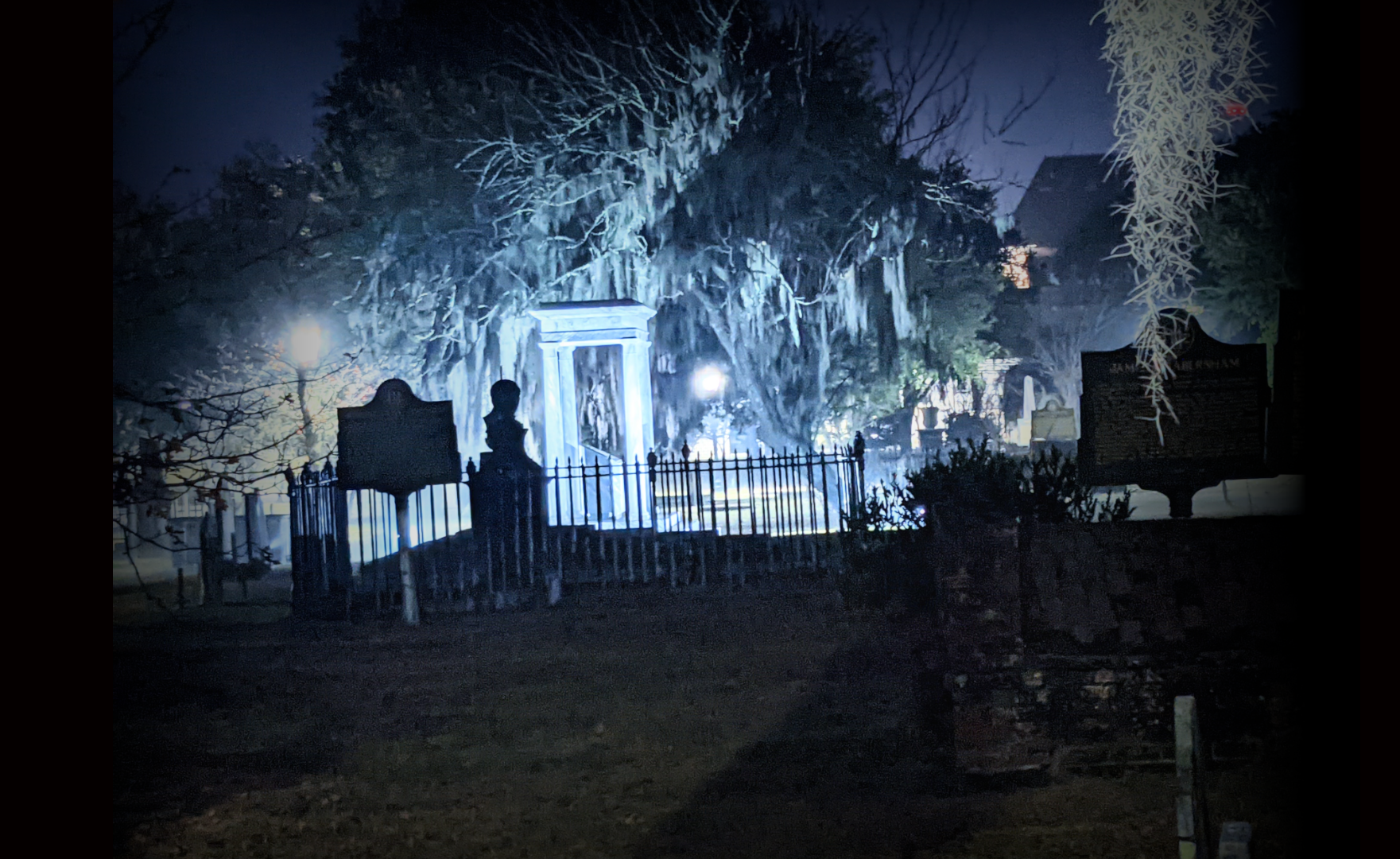
We know that Button Gwinnett is one of those signers, and his story isn’t difficult to find. The lead image for this column is his tomb by moonlight.
But who is the other signer in Colonial Park Cemetery?
Over the summer, I had the pleasure of attending the unveiling of the cannons at the Visitor Center’s Loyalists and Liberty exhibit. The rooms were thick with historians and enthusiasts. I felt certain that someone there would know who the second signer was.
I approached costumed representatives; no luck. I brought up the question with a group of important looking people (turns out they were- oh, the audacity). Still no luck.
They agreed it was a puzzle. Did I Google it, they said. Sure, but wasn’t I in a room of the best experts on the subject of the Revolutionary War in Savannah? I left feeling more curious than ever.
If you search the internet for local signers of the Declaration, three names will come up: Button Gwinnett, whose remains are believed to be near his memorial in Colonial Park Cemetery.
The other two, George Walton and Lyman Hall, are definitely not buried in Colonial Park Cemetery. They were reinterred beneath the Signers’ Monument in Augusta, Georgia, on July 4, 1848.
So why this long-standing belief that there are two signers in the cemetery downtown? At the cannon unveiling, we joked that 2 sounds better than one, and there might be some truth to that.
But there is also truth to there being two. Well, almost.
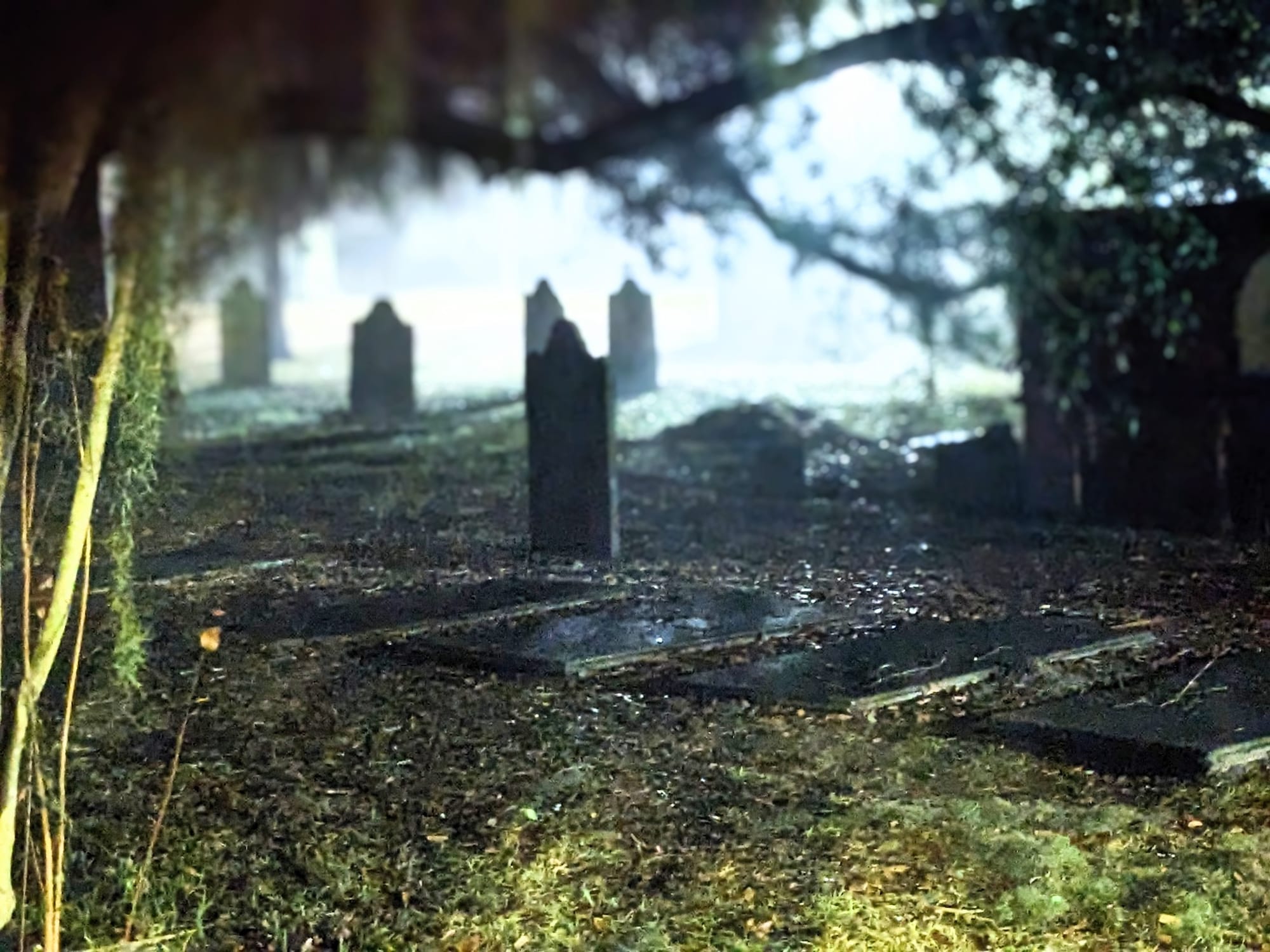
The answer is in local historian Elizabeth Piechocinski’s book, The Old Burying Ground: Colonial Park Cemetery. The confusion is understandable.
The second person, I believe, is William Leigh Pierce, a framer of the United States Constitution. He has no tombstone, and the exact location of his remains is unknown. Only that he died on December 10, 1789, and was buried in the old burying ground.
From Piechocinski’s book:
“Pierce represented Georgia in the Continental Congress of 1786 and 1787. As such, he took part in framing the new constitution, although, because he was called to New York on business, he was not present to sign the new Constitution of the United States.”
An interesting side note is that, according to The New Georgia Encyclopedia, the business he chose to deal with, rather than sign the Constitution, was to go shoot a man. A duel over “mishandled mercantile dealings” had become “so necessary it became unavoidable.”
The duel was prevented by his opponent’s second, Alexander Hamilton, and is one of the “affairs of honor” Hamilton was party to.
So there it is. History’s game of telephone has been played once again. Not a second signer of the Declaration of Independence, but a framer of the subsequent Constitution of the United States.
Why should such mysteries be solved?
Once, while leading a full tour along Colonial Park Cemetery, a local bishop, who was in a wonderful mood, stopped and addressed the group. He proudly said that there were two signers in the cemetery, and of course I couldn’t come up with the second one.
Obviously, he expected me to know, and obviously, I didn’t. His enthusiasm deflated like a balloon, and there went my credibility for the rest of that tour.
Knowing the truth about our history matters because we like to feel certain about our foundations. Our convictions shape us and give us a sense of security.
But what about taking a lighter stance? Many of the narratives we have grown up with are not exactly true.
Whether they have been presented for simplicity’s sake or with the intent of shaping society, it should be understood that there’s undoubtedly more to the story.
No need to get upset about it, just let the light in.
These days, the world’s information is at our fingertips like never before; it is a superpower unlocked. And with that great power comes the responsibility of stewardship of information.
What we think we know makes up the narrative that determines how we feel about ourselves and others.
How will accurate history be safeguarded once it is uncovered?
I have a serious concern about the disparaging tone used to describe our civilization. Is it perfect? Of course not.
But believing slanted truths and allowing yourself to be swept away by them is an indulgence in a type of vicious gossip, and only fuels the fire that could eventually burn us to the ground.
There’s also the practice of what I think of as “Gotcha History,” which can be heard on Savannah’s sidewalks, practiced by tour guides who understand that there are conflicts in the narrative, but haven’t gotten past the ego trip of attention from their audience.
Yes, the stories of our forefathers have been retold until they have morphed into over-the-top lore. But the answer isn’t to sneer at the founders of the society that currently supports you.
Why take that tactic when, along with mentioning the tragedies, you can showcase the strength and resilience (of every group) instead? Savannah, with all of its drama and problems, is still a successful and progressive city, along with being stunningly beautiful.
Great, now what?
Institutional focus is on the negative, and we all know why. An optimistic take would be that with our access to information, eventually being able to discern the difference between truth and false narratives could trend even more than supporting divisive rage bait. A chill knowingness could spread throughout the land…
A way to move forward could be to immediately enact protections for libraries and archives, and then mobilize an army of readers.
Chop information up into digestible videos, articles, and tours and send humanity’s truth out into the world.
Because if the current trends continue, knowledge will be only what your chosen AI model knows or chooses to share.
Use the superpower of access to information. Untangle reality like a knot or a puzzle. Make sure those disseminators are well funded….
Wait, what? This is already happening? Real experts sharing real information are online trying to circumvent destructive narratives?
So…"doomscrolling” might be a misnomer? Why would that narrative be pushed?