By Nicole Moore
Blessed be the man that spares these stones,
And cursed be he that moves my bones.
-- William Shakespeare’s epitaph
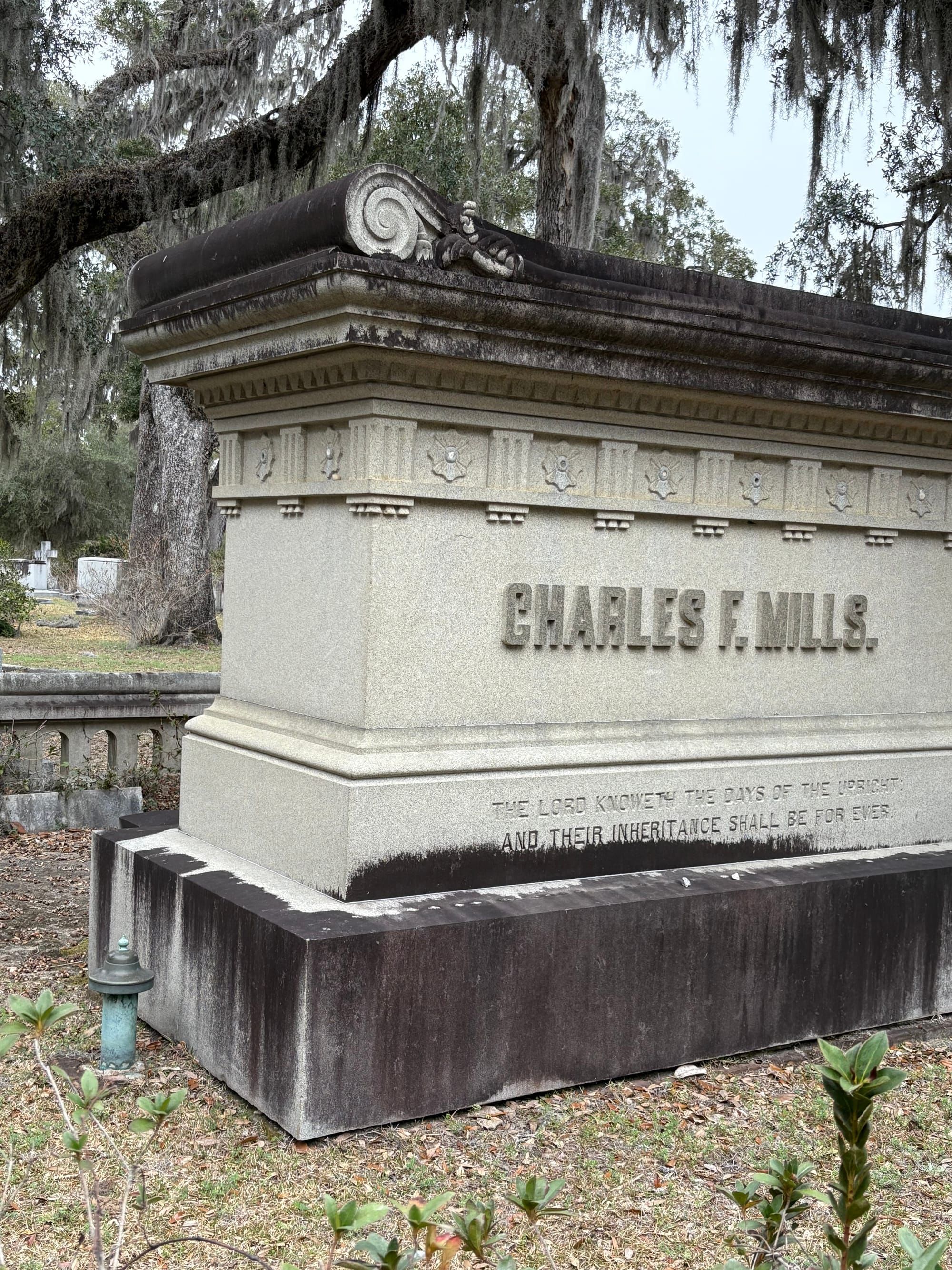
THERE is a bell tied to the body of a man in Bonaventure Cemetery. His name was Charles F. Mills, and he knew that he could be buried alive.
As a matter of fact, that was a legitimate fear for everyone. It was not always easy to discern whether someone was in a deep coma, or if they were actually dead.
This was especially true during the early outbreaks of Yellow Fever, over which hung terror of being infected oneself. People were buried hastily, because the belief was that the contagion was airborne. It wasn't until 1900 that people learned that mosquitoes transmit the disease.
Mistakes were made. Sometimes a vault would be opened to inter the next corpse, and there would be the previous one, at the door, clearly having tried to get out.
Imagine you are one of the people who come out of the coma. You crawl to the door, maybe there’s light shining through the bricked-up door.
You cry out weakly, throat parched. You wear your nails down trying to claw open your tomb.
It is no use. You later become one of the 219 confirmed cases of people in this area who were confirmed to be buried alive.
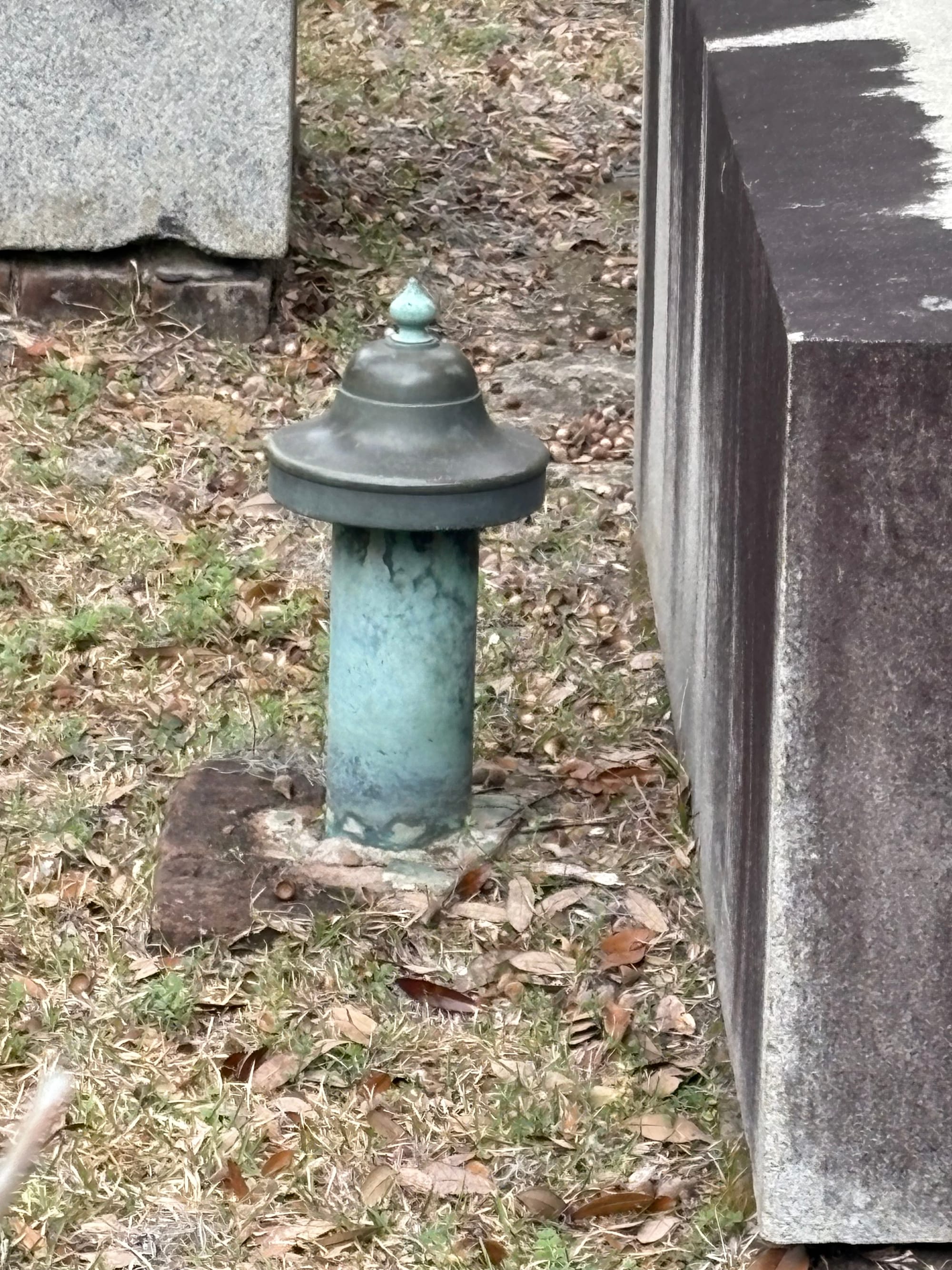
The answer to this horrifying reality was safety coffins. Here in Savannah, a safety coffin was a bell tied to a person’s fingers, with the string leading to a bell outside of the vault or coffin. If that person moved around, the bell would ring, and someone would know to dig them out.
This is a good system if someone is listening for the bell. This very important detail was handled by cemetery watchmen, or dedicated family members, or in some cases, soldiers.
The term “Graveyard shift” was born, and those who found themselves in the position of needing to accept such employment began to experience an illness of their own: Tombstone Madness. Below is a colorful explanation of the problem.
From the Philadelphia Times in the 1880s:
TOMBSTONE MADNESS
A New Form of Mania that Affects People Who Guard Cemeteries.
“If a man wants to enter this profession and be a success at it, he must be about as impressible as brick and mortar. If he has the least bit of imagination he had better abandon the business, for when the moon is obscured by clouds and he is walking about a cemetery, shivering from his heels upward, he will mistake tombstones for ghosts. He will think that the owls, as they whiz past his ears with their mournful hoots, are unquiet spirits come to haunt the receptacles of the bodies which they once permeated. When the noise of his footsteps makes the rats disappear with rustling sound into little thickets of evergreens he will start and grasp his weapon. The very whine of his dog will make him feel nervous, and bit by bit his reason would become impaired.”
Cemetery watchmen would lose their grip on reality, descending into madness and finding themselves committed to the local lunatic asylum, or in some tragic cases becoming corpses themselves.
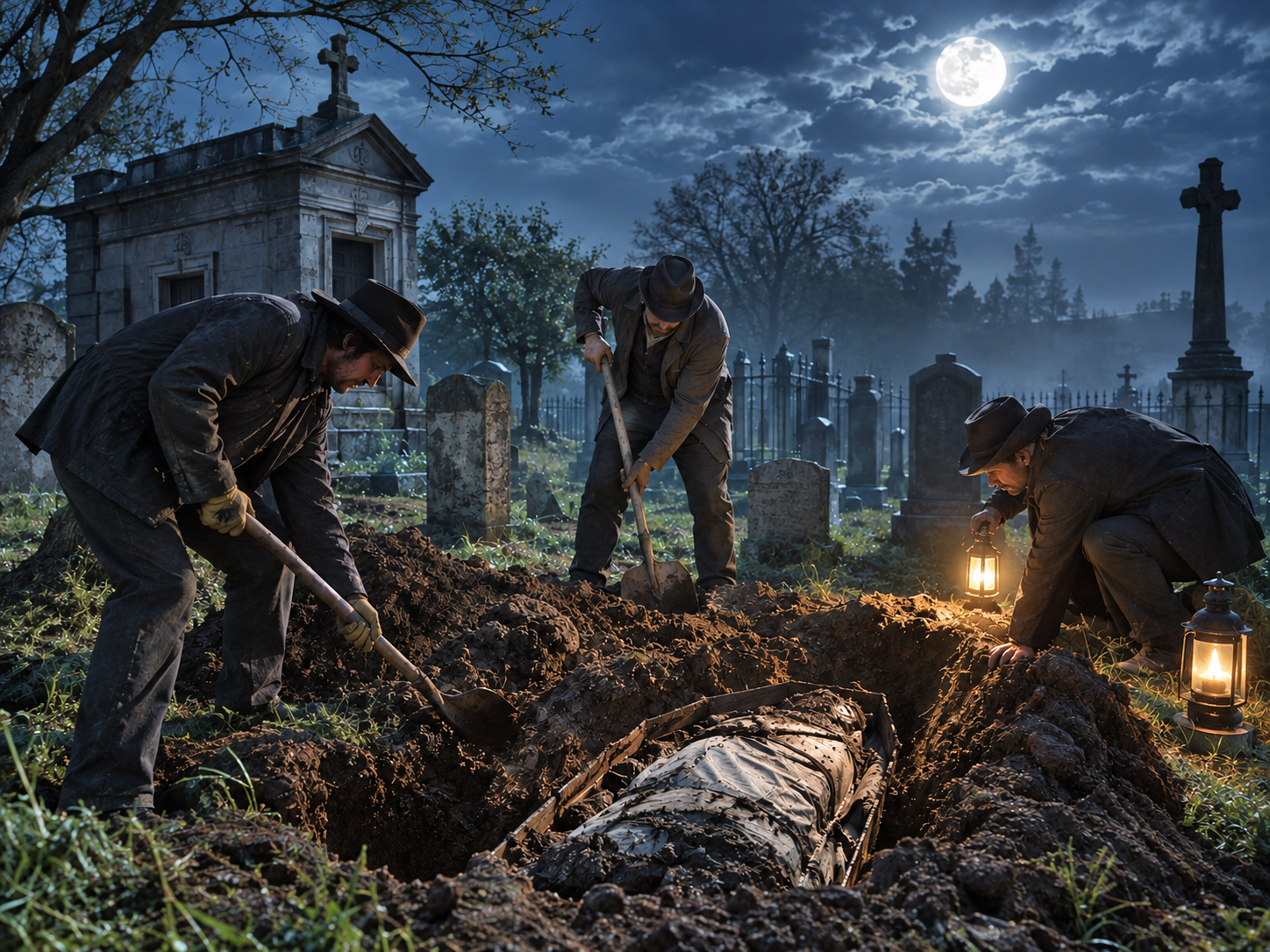
Listening for bells tied to buried people wasn’t the only job these watchmen had; they also guarded against grave robbers. They relieved the corpses of their valuables, but also stole the bodies themselves.
This practice was known as “body snatching,” and the people who did it were known as “Resurrectionists.”
Corpses were in high demand for anatomists, mostly to be used in medical schools. Legal opportunities to acquire a cadaver for dissection could be hard to come by, since only those who donated their bodies to science, or criminals, could be used for this purpose.
With a heavy stigma attached to corpse mutilation, the demand far outweighed the supply. So an industry was born, and a newly dead body became a hot commodity.
A Resurrectionist could make quite a lot of money from one cadaver. Some considered the effort and risk of entering a cemetery in the cover of darkness and hauling away a fresh, floppy one an acceptable challenge.
Of course, it did occur to some that corpses could be made for such purposes.
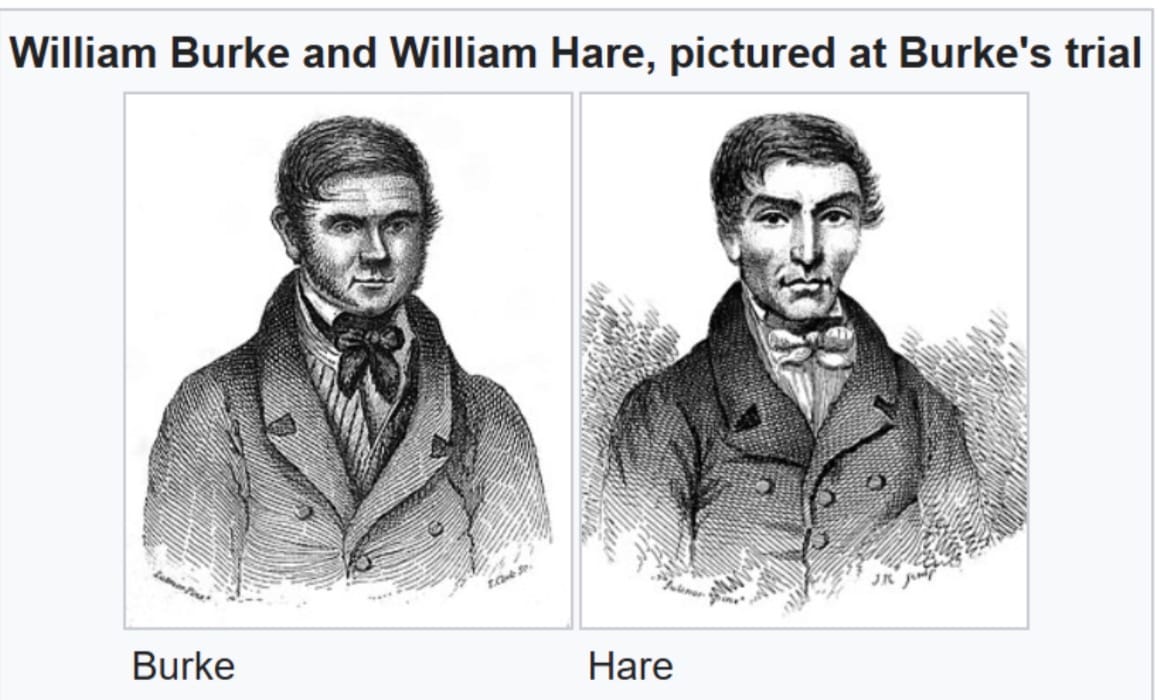
Enter William Burke, and his accomplices William Hare, and their two wives. In Edinburgh, Scotland, in 1827, Burke was a lodge keeper.
After a tenant died owing rent, he and Hare decided to sell the body to a local surgeon, Robert Knox, for the sum of 7 pounds, 10 shillings.
Too easy, they said, and expanded the enterprise to include murdering lodgers by smothering them and selling their bodies to the same surgeon’s medical school.
They were arrested on Halloween (the dead will speak, won’t they?) 1828, and the term “Burked” will live on as meaning being killed for profit for medical research.
Personal accounts from the local community are always interesting, and there are plenty of stories of experimental medical practices performed by local surgeons in Savannah in the 19th century. If Savannah has such secrets, however, they are well kept.
Recently, I asked born-and-raised local friends at the Second Bryan Baptist Church if they ever heard stories of corpses being stolen from graveyards. As elder members of the community, they had never heard such rumors, even as the type of scary stories children pass around.
But just up the road, Augusta has quite the tale.
In the mid 1800s, the Georgia Medical College found itself in the same predicament that other colleges were in: how to serve the needs of medical students amidst the shortage of cadavers?
They solved the problem by enlisting Grandison Harris, a burly, formerly enslaved Gullah, to enter cemeteries and remove the recently dead. Grandison was employed by the college and had formerly held the position of Reconstruction judge in South Carolina, until Jim Crow laws destroyed the position.
\His considerable capabilities were put to use by the college for body snatching, and he was so successful he became known as the Resurrection Man. During the day he was well liked and sociable in the community, but at night his successes included being so good at rearranging floral displays on graves that no one could tell the body had been stolen.
Since African American graves were targeted by grave robbers because they had little recourse to pursue justice, the continual theft of their bodies spawned what is referred to as folklore about the “Night Doctor.”
This folklore was true. In 1889, construction workers would uncover over 10,000 bones buried under Georgia Medical College.
Neither the college nor Harris were ever charged with a crime, and he passed at the age of 95 in 1911 of heart failure. His tombstone reads, “Known Only To God.”